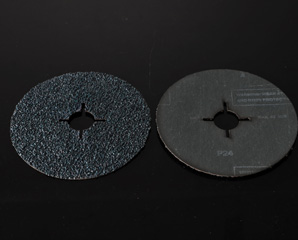
In industrial sanding operations, choosing the right abrasive disc involves more than selecting a grit number. The backing material, adhesive performance, abrasive grain, coating structure, and disc dimensions all influence how effectively a sanding disc performs during production. For manufacturers, automotive repair facilities, furniture factories, and industrial distributors, these factors can affect surface consistency, abrasive consumption, and workflow efficiency.
PSA sanding discs, also known as pressure-sensitive adhesive sanding discs, are designed with an adhesive backing that attaches directly to a compatible sanding pad or platen. Unlike hook-and-loop discs, they provide a different mounting method that can be useful in applications where a secure, flat attachment is required.
Understanding how these components work together helps buyers select suitable products for their equipment and production requirements.
A PSA sanding disc uses a pressure-sensitive adhesive layer to attach the abrasive disc to a compatible backing pad. The operator positions the disc against the pad and applies pressure to establish contact.
The main advantage of this mounting design is its relatively simple attachment structure. However, reliable performance depends on compatibility between the adhesive backing and the mounting surface.
Before purchasing, buyers should consider three factors:
Pad compatibility: The sanding machine must use a suitable smooth mounting surface designed for adhesive-backed abrasives.
Disc alignment: Incorrect positioning can create uneven contact and affect sanding consistency.
Adhesive condition: Dust, oil, moisture, and excessive heat may reduce adhesion and cause premature lifting.
PSA discs should not be treated as interchangeable with hook-and-loop sanding discs. Their mounting systems are different, so buyers should confirm the required attachment method before placing bulk orders.

The abrasive backing, grain type, and coating structure determine how a PSA sanding disc responds to different materials and working conditions.
Paper backing is commonly used in coated abrasive discs because it provides a flexible foundation for abrasive grains. Different paper weights offer different balances of flexibility and durability.
For example, C-weight paper provides a relatively strong backing compared with lighter paper grades. It can be considered for applications requiring more support during sanding, although the final choice should also account for workpiece shape and operating pressure.
Aluminum oxide is widely used for general-purpose sanding because of its versatility across different materials. Silicon carbide is another abrasive mineral used in applications requiring different cutting and finishing characteristics.
The appropriate grain depends on the workpiece material, removal requirements, and desired surface condition.
Coating density influences how abrasive grains interact with the workpiece. Open or semi-open coating structures can provide more space for sanding debris, helping reduce loading in applications involving materials such as paint, primer, and some plastics.
For example, RMC's AP33M PSA sanding discs use aluminum oxide and zirconia abrasive grains, C-weight latex paper backing, and a semi-open coating with a load-resistant treatment. The product is designed for applications involving paint, primer, wood, metal, plastic, and composites.
These specifications demonstrate why buyers should compare the complete abrasive construction rather than choosing products based on grit size alone.
Disc diameter is an important purchasing consideration because the abrasive must match the sanding equipment and backing pad.
A disc that does not fit the mounting surface correctly may create alignment problems, uneven contact, or exposed areas that interfere with the sanding process.
Before ordering, industrial buyers should confirm:
The required disc diameter.
The mounting pad dimensions.
Whether the equipment uses a central hole or a specific attachment configuration.
The intended sanding application.
The available grit range required for the production process.
For example, automotive refinishing operations may require different disc sizes depending on the sanding machine and work area. Larger flat surfaces and smaller curved components can have different equipment and handling requirements.
Buyers should also consider whether several disc diameters need to be included in the same procurement order. Confirming these details before production helps reduce compatibility issues and unnecessary inventory.
Even a suitable abrasive disc may perform poorly when storage, mounting, or operating conditions are incorrect.
A disc that begins lifting during operation may have been exposed to contamination, moisture, excessive heat, or an unsuitable mounting surface. Before installation, the backing pad should be clean, dry, and free from loose abrasive debris.
Loading occurs when sanding dust and removed material accumulate between abrasive grains. This reduces the exposed cutting area and can decrease sanding efficiency.
Selecting a suitable coating structure and abrasive type can help reduce this problem. Dust extraction and appropriate operating practices are also important.
Uneven contact pressure, a damaged backing pad, incorrect disc positioning, or an unsuitable grit selection may produce inconsistent surface finishes.
A practical troubleshooting process should begin with checking the equipment, workpiece condition, disc attachment, and abrasive specification rather than immediately changing to a different product.
For wholesalers, distributors, and industrial manufacturers, accurate product specifications are essential when sourcing PSA sanding discs.
A complete purchasing inquiry should include:
| Specification | Information to Confirm |
|---|---|
| Product type | PSA sanding disc |
| Disc diameter | Required diameter and mounting configuration |
| Abrasive grain | Aluminum oxide, zirconia, or other required grain |
| Grit size | Required coarse, intermediate, and fine grades |
| Backing | Paper type and weight |
| Coating | Open, semi-open, or other specified construction |
| Application | Wood, metal, paint, primer, plastic, or composites |
| Packaging | Quantity, labeling, and packaging requirements |
Buyers should also request product samples when evaluating a new supplier or changing an existing abrasive specification. Testing samples under actual working conditions can help determine whether the product is compatible with the equipment and production process.
RMC Abrasives offers different PSA disc options, including AP23M, AP33M, A35PM, AP36M, and AP50M. Buyers can compare their backing, abrasive construction, and application requirements through the PSA sanding disc product range.
For buyers requiring a specific abrasive construction, the AP33M PSA sanding disc provides an example of a product designed for high-production sanding and general-purpose applications.
Selecting PSA sanding discs for industrial production requires a coordinated evaluation of adhesive backing, disc dimensions, abrasive grain, coating structure, and workpiece requirements.
A suitable product should match the sanding equipment, provide the required cutting and finishing characteristics, and remain compatible with the intended production process. For bulk buyers, reviewing complete specifications and evaluating samples before large orders can reduce purchasing risks and improve product consistency.
RMC Abrasives supplies multiple PSA sanding disc options for different industrial applications. By comparing product specifications and discussing application requirements with the manufacturer, distributors and production buyers can identify abrasive solutions that better match their operational needs.
PSA sanding discs use a pressure-sensitive adhesive backing to attach to a compatible pad, while hook-and-loop discs use a mechanical fastening system. The correct option depends on the sanding equipment and the preferred disc replacement method.
Yes. PSA sanding discs can be used in automotive applications such as sanding paint, primer, and body repair surfaces. The abrasive grain, grit size, backing, and coating should be selected according to the specific operation.
Available grit sizes depend on the product model and manufacturer. RMC's AP33M PSA sanding discs are listed in a range from P40 to P1200, providing options for different sanding and finishing stages.
Possible causes include contamination on the backing pad, excessive heat, moisture, poor disc alignment, or unsuitable mounting conditions. Checking the pad surface and storage conditions can help prevent premature adhesive failure.
Wholesalers should confirm disc dimensions, grit range, abrasive grain, backing material, coating structure, packaging, and intended applications. Requesting samples before large-volume orders is also a practical way to evaluate product compatibility and consistency.
Silicon Carbide Sanding Belts for Glass: Abrasive Selection, Surface Quality and Process Considerations
How to Evaluate Flap Disc Manufacturers: Quality Control, Product Consistency and OEM Capabilities
Cleaning Sanding Discs vs. Grinding Discs: How to Choose the Right Abrasive for Surface Preparation
 EN
 ko
 fr
 de
 es
 it
 ru
 vi
 th
 pl
 pt