When grinding stainless steel or titanium alloys, heat is the variable that turns a productive shift into a rework problem. The blue-purple discoloration that appears on a stainless surface after aggressive grinding is not cosmetic—it is a visible indicator of surface oxidation caused by excessive temperature, and it signals that the metallurgical and corrosion-resistance properties of the surface layer have been compromised. In food-grade fabrication, pharmaceutical equipment manufacturing, and decorative stainless applications, a heat-tinted surface is a rejection, not a touch-up. In titanium and high-alloy aerospace components, thermal micro-cracks from grinding heat can be invisible to the naked eye but catastrophic in service.
Procurement teams evaluating fiber disc options frequently focus on fiber disc price as the primary comparison variable. This is understandable—disc consumption is a visible, recurring cost that is easy to compare between suppliers. But in real production, the cost of heat damage on high-value stainless and titanium parts dwarfs the cost difference between a standard disc and a correctly specified cool-cut disc. A single rejected part, an additional polishing cycle, or an inconsistent passivation result from heat-affected surface chemistry can cost more than an entire month's disc consumption.
The solution is not slower grinding or lower pressure—it is a fiber disc specification that keeps the cut cool under the pressure conditions of real production. This guide covers the heat generation mechanism, the grinding aid technology that controls it, the specifications that determine cool-cut performance, and the TCO framework that makes the case for specifying correctly rather than buying on price.
Understanding why stainless steel develops heat discoloration during grinding makes it possible to specify the disc properties that prevent it. The mechanism is straightforward, but the interactions between disc specification, machine settings, and operator technique are more complex than they appear.
In abrasive grinding, heat is generated at the contact zone between the abrasive grain and the workpiece surface. When a sharp grain cuts cleanly through the metal, the energy input is converted primarily into chip formation—material removal—with relatively low heat generation at the contact point. When a grain is dull, loaded with metal debris, or moving too slowly relative to the workpiece, it rubs rather than cuts. Rubbing converts energy input into heat rather than material removal, and the temperature at the contact zone rises rapidly.
Stainless steel is particularly susceptible to heat damage from rubbing because it has lower thermal conductivity than carbon steel—heat generated at the grinding contact zone dissipates more slowly into the workpiece, concentrating at the surface. The chromium oxide passive layer that gives stainless steel its corrosion resistance begins to break down at temperatures above approximately 300°C, producing the visible blue-purple oxide discoloration that indicates surface damage. At higher temperatures, thermal gradients in the surface layer can produce micro-cracks that are not visible without magnification but that compromise the structural integrity of the part.
Three conditions accelerate heat generation in fiber disc grinding: excessive pressure that overloads the abrasive grains and causes rubbing rather than cutting; incorrect RPM that reduces grain cutting speed below the efficient range; and disc loading—the accumulation of metal debris between abrasive grains—that reduces the effective cutting surface and increases friction.
The goal of cool-cut disc specification is to maintain efficient chip formation—sharp grains cutting cleanly—while minimizing the friction and adhesion between the abrasive surface and the stainless steel workpiece. These two objectives are addressed by different aspects of the disc specification: grain type and bond system determine cutting efficiency and grain renewal behavior; grinding aid coating addresses friction and adhesion at the grain-workpiece interface.
For product specifications and configuration options, see the fiber disc product page here.
The grinding aid—also called top-size coating or supersize coating—is the disc specification that most directly addresses heat generation in stainless steel and titanium grinding. It is also the specification that is least understood by buyers who evaluate fiber disc price without understanding what determines cost per finished part.
A grinding aid is a chemical coating applied over the abrasive layer as the outermost surface of the disc. It is distinct from the maker coat (which anchors the abrasive grains to the backing) and the size coat (which locks the grains in position)—it sits on top of the abrasive layer and is the first material to contact the workpiece during grinding.
The grinding aid formulation—typically based on potassium fluoroborate, cryolite, or similar compounds depending on the application—performs two functions simultaneously. First, it provides a lubricating effect at the grain-workpiece interface, reducing the friction coefficient between the abrasive grain and the metal surface. Lower friction means less heat generation per unit of material removed. Second, it inhibits metal adhesion to the abrasive surface—the mechanism by which stainless steel and other ductile metals smear onto and between abrasive grains, loading the disc and converting cutting action into rubbing.
The combined effect is that a disc with grinding aid maintains "cold cut" behavior—efficient chip formation with low heat generation—under the pressure conditions that would cause a standard disc to load, rub, and generate damaging heat. The grinding aid is consumed during use as the disc wears, but it is continuously renewed as fresh abrasive surface is exposed through the self-sharpening process.
The benefit of grinding aid is most significant under the high-pressure conditions that operators use when trying to maximize material removal rate. Without grinding aid, increasing pressure beyond the optimal range causes the disc to load more quickly and generate more heat—a counterproductive outcome where more effort produces more damage. With grinding aid, the lubrication and anti-loading effect extends the pressure range over which the disc cuts efficiently, allowing operators to maintain productive material removal rates without crossing the temperature threshold that causes blueing.
This is the practical reason why cool-cut fiber discs with grinding aid are specified for stainless steel and titanium applications even when the initial fiber disc price is higher than standard alternatives. The disc maintains its cutting efficiency under the pressure conditions of real production, rather than degrading into a heat-generating rubbing tool that damages the workpiece.
When evaluating fiber disc suppliers for stainless steel and titanium applications, request specific information about the grinding aid specification:
Whether the disc uses grinding aid, and the chemical type (relevant for compatibility with specific alloys and surface finish requirements)
Which metals the grinding aid is optimized for—formulations for stainless steel may differ from those for titanium or nickel alloys
Recommended RPM range and pressure guidance for cool-cut performance with the specific disc specification
Whether the grinding aid is present across the full disc surface or only in specific zones
A supplier who can answer these questions specifically is managing the grinding aid specification actively. A supplier who describes the disc as "suitable for stainless" without being able to specify the grinding aid formulation is not.
A fiber disc procurement decision based on price per unit without evaluating the specifications that determine cool-cut performance will consistently produce the wrong outcome for stainless steel and titanium applications. These are the specifications that determine whether a disc protects the workpiece or damages it.
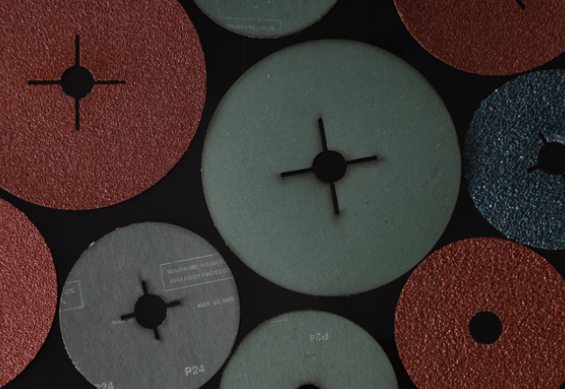
Abrasive grain type
Grain type determines cutting efficiency, heat generation per unit of material removed, and disc life. For stainless steel and titanium, grain types engineered for low heat generation and resistance to metal adhesion are the appropriate specification. Request the supplier's recommendation for the specific alloy grade and application—weld removal, flat grinding, or blending—rather than accepting a generic "suitable for stainless" claim.
Resin bond and heat resistance
The resin bond system must maintain its structural integrity under the heat generated during grinding. A bond that softens or degrades at elevated temperatures releases grains prematurely, reducing disc life and producing inconsistent cut rate. Heat-stable resin formulations maintain bond hardness across the temperature range encountered in stainless steel grinding, providing consistent grain retention and self-sharpening behavior throughout the disc's service life.
Grinding aid and top-size presence
As described above, grinding aid is the primary specification for heat control in stainless steel and titanium grinding. Confirm that the disc specification includes grinding aid and that it is formulated for the target alloy. This is the non-negotiable specification for applications where heat discoloration is a rejection criterion.
Backing fiber stiffness and thickness
Stiffer, thicker fiber backing provides more aggressive stock removal and better control on flat surfaces. More compliant backing conforms better to curved surfaces and is appropriate for blending and finishing operations. Match the backing specification to the application—using a stiff backing for blending work generates more heat from the increased contact pressure at the disc edge.
Grit selection and sequence strategy
Avoid large grit jumps between sanding stages—jumping from a coarse grit to a fine grit leaves scratches that the fine grit cannot efficiently remove, requiring more dwell time and generating more heat. Optimize the grit sequence to minimize the total heat input required to reach the target surface condition.
Backing pad compatibility
Pad hardness affects the contact area between the disc and the workpiece. A harder pad concentrates pressure on the disc face, which increases material removal rate but also increases heat generation. A softer pad distributes pressure more evenly, which reduces heat generation but also reduces removal rate. Match pad hardness to the application—harder pads for flat stock removal, softer pads for blending and finishing on curved or irregular surfaces.
The cost benefit of cool-cut fiber disc specification is most significant in specific production contexts where heat damage has the highest downstream cost.
Stainless weld removal and beveling
Weld grinding on stainless steel is the highest-heat application in most fabrication shops—the weld bead requires aggressive material removal, and the heat-affected zone around the weld is already metallurgically stressed. Heat discoloration from grinding on top of weld heat input produces a surface that requires extensive polishing to restore the passive layer and achieve a consistent brushed or mirror finish. Cool-cut discs with grinding aid reduce the additional heat input from grinding, limiting the discoloration zone and reducing the polishing work required after grinding.
Food-grade and pharmaceutical stainless fabrication
Surface quality in food-grade and pharmaceutical equipment is a compliance requirement, not just an aesthetic preference. Heat-tinted surfaces on stainless steel equipment can indicate passive layer damage that affects cleanability and corrosion resistance—both of which are relevant to regulatory compliance. Specifying cool-cut fiber discs for all grinding operations on food-grade and pharmaceutical stainless is a process control decision that protects compliance outcomes.
Titanium parts and high-value aerospace components
Titanium has even lower thermal conductivity than stainless steel, making it more susceptible to heat damage from grinding. The scrap cost of a heat-damaged titanium component—material cost plus machining time—is substantially higher than the cost difference between a standard and cool-cut disc specification. For any titanium grinding application, grinding aid specification is not optional.
Decorative stainless with No. 4 or brushed finishes
Decorative stainless applications—architectural panels, kitchen equipment, elevator interiors—require consistent surface finish across large areas. Any heat discoloration or heat haze is immediately visible against the surrounding brushed finish and requires re-grinding and re-finishing of the affected area. Cool-cut disc specification prevents the discoloration that makes decorative stainless rework necessary.
RPM management: confirm that the grinder RPM is within the disc's rated speed range. Operating above the rated speed increases heat generation and disc wear; operating significantly below the rated speed reduces cutting efficiency and increases dwell time, which also increases heat input per unit area.
Steady motion: maintaining consistent motion across the workpiece surface prevents heat concentration in one area. Dwelling in one spot—even briefly—allows heat to accumulate at the contact zone and can cause localized blueing even with a cool-cut disc.
Pressure optimization: the grinding aid extends the pressure range over which the disc cuts efficiently, but there is still an upper pressure limit beyond which heat generation increases faster than material removal rate. Use the pressure that produces efficient chip formation—visible metal removal with clean chips—rather than the maximum pressure the operator can apply.
Disc replacement timing: replace discs before they become dull enough to rub rather than cut. A dull disc generates more heat per unit of material removed than a fresh disc, and the heat damage from the last 20% of a disc's life can exceed the heat damage from the first 80%. Establish a disc replacement schedule based on material removal rate rather than waiting for visible disc degradation.
The total cost per finished stainless part includes costs that are not visible in the disc unit price comparison:
| Cost element | Standard disc | Cool-cut disc with grinding aid |
|---|---|---|
| Disc cost per part | Lower | Slightly higher |
| Rework from heat discoloration | Higher | Lower |
| Additional polishing steps | More frequent | Less frequent |
| Part rejection rate | Higher on heat-sensitive alloys | Lower |
| Passivation re-treatment cost | Higher | Lower |
| Total cost per finished part | Higher | Lower |
For a fabrication shop processing stainless steel components where heat discoloration is a rejection criterion, the rework and rejection cost from standard discs typically exceeds the price premium of cool-cut discs within the first month of production. The payback is immediate and compounding—every avoided rejection and every eliminated polishing step reduces cost per finished part.
Heat discoloration and thermal damage on stainless steel and titanium are predictable outcomes of excessive friction, disc loading, and dull abrasives—not operator mistakes. The correct response is not slower grinding or lower pressure, but a fiber disc specification that maintains cool cutting under the pressure conditions of real production. A fiber disc with grinding aid top-size coating reduces friction and inhibits metal adhesion at the grain-workpiece interface, keeping the cut clean and the surface temperature below the threshold that causes blueing and passive layer damage.
The best value in stainless steel grinding is not the lowest fiber disc price—it is the lowest cost per finished part, which includes rework, polishing, rejection, and passivation costs that a standard disc generates and a cool-cut disc prevents.
Ready to specify the right cool-cut fiber disc for your stainless steel or titanium grinding application? Submit your requirements for an accurate specification recommendation and quotation.
Visit the Fiber Disc Product Page
To receive a specific recommendation, provide the following:
Work conditions: Material grade (304, 316, 2205, titanium, nickel alloy), application type (weld removal, flat grinding, blending, beveling), dry or assisted cooling, grinder RPM and power rating
Quantity: Monthly disc consumption, trial order quantity, target contract volume
Size and specifications: Disc diameter, grit range, backing pad hardness, target material removal rate, surface finish requirement after grinding
Target metrics: No-blueing requirement, maximum acceptable heat tint area, cycle time target per part, disc life target
Current problem: Blue or purple heat discoloration, disc loading or clogging, burn marks, suspected thermal micro-cracks, excessive rework or polishing steps, inconsistent passivation results
1. What is a fiber disc?
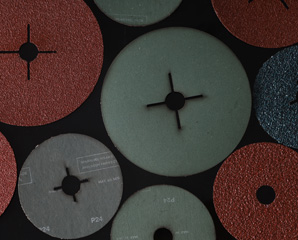
A fiber disc is a resin-bonded coated abrasive disc built on a vulcanized fiber backing—a dense, stiff paper-based material that provides the structural rigidity required for angle grinder applications. Fiber discs are used with a backing pad on angle grinders for stock removal, weld grinding, beveling, and surface blending on metal, stainless steel, titanium, and other materials. They are specified by diameter, grit, abrasive grain type, bond system, and—for heat-sensitive applications—the presence and type of grinding aid top-size coating. The vulcanized fiber backing provides the combination of stiffness and toughness required for the high contact pressures used in angle grinder applications.
2. How does a fiber disc compare with flap discs or grinding wheels for stainless steel?
Fiber discs provide fast stock removal with the ability to progress through grit sequences for finishing, and with grinding aid specification they are well suited for heat-sensitive stainless and titanium applications. Flap discs—overlapping abrasive flaps on a hub—provide a more forgiving contact geometry that is easier to control for blending and finish work, and they generate somewhat less heat than fiber discs at equivalent removal rates because the flap geometry distributes contact pressure. Grinding wheels provide the highest material removal rates but generate the most heat and leave the deepest scratch patterns, making them less appropriate for applications where surface finish and heat discoloration are critical. The correct choice depends on the removal rate required, the target surface finish, and the heat sensitivity of the workpiece material.
3. How do I evaluate ROI beyond fiber disc price for stainless steel applications?
Measure total cost per finished part rather than disc cost per unit. The relevant inputs are: disc cost per part (disc price divided by parts per disc), labor time to reach the target surface condition, rework rate from heat discoloration (including re-grinding and re-polishing labor and materials), part rejection rate from heat damage, and any additional passivation or surface treatment cost required after heat-affected grinding. For stainless steel applications where heat discoloration is a rejection criterion, a cool-cut disc with grinding aid that eliminates rework and rejection will have a lower total cost per finished part than a cheaper standard disc that generates heat damage, even if the unit price difference is significant.
4. Do we need to modify our grinding process to use fiber discs with grinding aid?
No equipment changes are required. The grinding aid coating is a disc specification change, not a process equipment change. The process adjustments that maximize cool-cut performance are operational: confirming that the grinder RPM is within the disc's rated range, optimizing pressure to the efficient cutting range rather than maximum pressure, maintaining steady motion to prevent heat concentration, and replacing discs before they become dull enough to rub rather than cut. These adjustments improve performance with any disc specification and are particularly important for maximizing the benefit of grinding aid coating.
5. What parameters should I provide for correct fiber disc selection and an accurate quotation?
Provide: material grade and alloy specification (304, 316, 2205, titanium grade, nickel alloy), application type (weld removal, flat grinding, blending, beveling), grinder RPM and power rating, disc diameter, current grit sequence, backing pad hardness, target surface finish or Ra value after grinding, current defect symptoms (blueing, burn marks, loading, clogging, inconsistent finish), monthly disc consumption volume, and any specific surface quality requirements—such as no-blueing standards, passivation requirements, or regulatory surface finish specifications for food-grade or pharmaceutical applications.
How Non Woven Grinding Discs Deliver Uniform Surface Finishes while Preserving Material Integrity
When Sandpaper Pads Fail: Understanding Common Causes of Poor Sanding Performance
Avoiding Common Mistakes When Choosing and Using Steel Wool Abrasives for Surface Finishing
 EN
EN
 ko
ko  fr
fr  de
de  es
es  it
it  ru
ru  vi
vi  th
th  pl
pl  pt
pt