In automotive refinishing, pigtails are one of the most expensive defects a shop can produce—not because they are difficult to understand, but because they are almost always discovered after paint has been applied. The spiral scratch pattern that gives pigtails their name is invisible on a sanded primer surface under shop lighting, passes undetected through the paint application stage, and reveals itself only under the gloss of a clearcoat or in direct sunlight on the finished vehicle. At that point, the rework cost includes stripping the clearcoat, re-sanding, re-painting, and re-clearing—a sequence that can consume several hours of technician time and significant material cost on a single panel.
The root cause is not sanding technique. It is dust management. When traditional sandpaper clogs—and on automotive primers, body fillers, and sealers, clogging happens quickly—the compacted sanding debris forms hard nodules on the disc surface. Under the orbital motion of a dual-action sander, these nodules drag across the surface in a spiral path, cutting scratches that are deeper and more irregular than the abrasive grain itself would produce. The result is a scratch profile that is inconsistent with the grit specification, unpredictable in depth, and invisible until it telegraphs through the paint film.
A mesh sanding disc addresses this problem at the source. The open mesh structure allows sanding dust to evacuate through the entire abrasive surface area—not just through punched holes in a paper backing—eliminating the loading mechanism that creates the hard nodules responsible for pigtails. For automotive refinishing shops and high-gloss furniture manufacturers where surface quality before coating determines the final result, the mesh disc is a process control tool, not just an abrasive consumable.
The pigtail defect mechanism is a direct consequence of how traditional paper-backed sanding discs interact with the soft, resinous materials used in automotive refinishing. Understanding the mechanism makes it possible to specify the disc structure that prevents it.
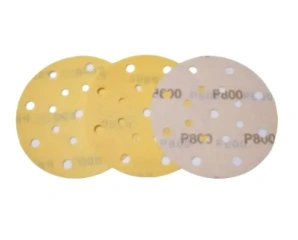
Traditional sandpaper uses a solid paper or film backing with abrasive grain coated on the surface. Dust extraction occurs through punched holes in the disc—typically five, six, or eight holes arranged to align with the holes in the backing pad. Between these holes, the disc surface is solid, and sanding dust that is not immediately captured by the extraction holes accumulates on the abrasive surface.
On automotive primers, body fillers, and sealers—materials that are soft, resinous, and generate fine, sticky dust—this accumulation happens rapidly. The sanding debris compacts between abrasive grains, forming a layer of hardened material on the disc surface. As the disc continues to rotate under orbital motion, these compacted nodules make contact with the workpiece surface. The nodule is harder than the surrounding abrasive grain and cuts a deeper, more irregular scratch. Under the combined rotational and orbital motion of a dual-action sander, the path of this nodule across the surface traces a spiral—the pigtail scratch.
Heat accelerates the process. Friction between a loaded disc and the workpiece generates heat that softens the resin in primers and fillers, making the surface more adhesive and accelerating the rate at which sanding debris bonds to the disc surface. In warm shop environments or when sanding with excessive pressure, loading can occur within minutes of starting a fresh disc.
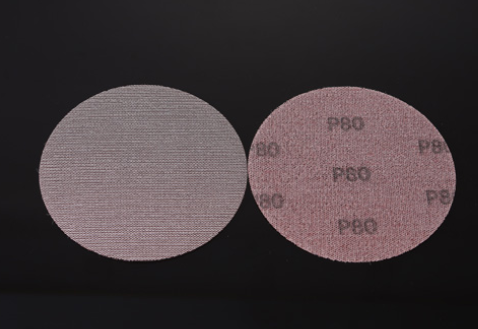
A mesh sanding disc replaces the solid paper backing with an open mesh structure—a network of abrasive-coated fibers with open spaces between them across the entire disc surface. When used with a vacuum-equipped sander, air is drawn through the entire disc surface area, not just through punched holes. Sanding dust is evacuated at the point of generation—at the abrasive grain contact zone—before it has the opportunity to accumulate and compact into nodules.
The practical result is that the disc surface remains clean throughout the sanding operation. Without the accumulation of compacted debris, there are no hard nodules to create pigtail scratches. The abrasive grains remain exposed and cutting efficiently, maintaining the scratch profile that corresponds to the specified grit rather than the irregular, deep scratches produced by loaded paper.
For product specifications and configuration options, see the mesh sanding disc product page here.
The elimination of pigtails is the most visible benefit of mesh sanding discs, but the more fundamental quality benefit is Ra consistency—the stability of the surface roughness profile across the sanded area. Ra consistency is the specification that determines whether a sanded surface will accept coating uniformly and produce a predictable gloss result.
Surface roughness—measured as Ra, the arithmetic mean of surface profile deviations—determines how a coating adheres to and flows over a sanded surface. A surface with consistent Ra across the panel provides uniform coating adhesion and uniform film build, which produces consistent gloss and color in the finished paint. A surface with variable Ra—areas of different roughness caused by loading, nodule scratches, or inconsistent disc wear—produces variable coating adhesion and film build, which shows as gloss variation, color mismatch, or texture differences in the finished paint.
For automotive refinishing, Ra consistency matters at every stage of the sanding sequence:
Primer sanding before basecoat and clearcoat: the primer surface must have consistent Ra to provide uniform adhesion for the basecoat. Random deep scratches from loaded paper discs create localized areas of higher Ra that absorb more basecoat, producing color variation that is visible in the finished paint.
Blending zones: where a repair blends into the surrounding original paint, the sanded surface must have consistent Ra to ensure that the new clearcoat flows and levels uniformly across the blend zone. Inconsistent Ra in the blend zone produces a visible boundary between the repaired and original areas.
High-gloss furniture finishing: on furniture panels destined for high-gloss lacquer or polyurethane topcoats, any variation in surface roughness before the sealer coat will telegraph through the finish as texture variation. The high gloss amplifies surface texture differences that would be invisible under a matte finish.
The Ra inconsistency produced by loaded paper discs is not uniform—it is random and localized. A paper disc that is 80% clean will produce consistent Ra across most of the panel, with random deep scratches in the areas where nodules have formed. These random deep scratches are the most problematic type of surface defect for paint quality because they are unpredictable in location and depth, and they are not detectable by visual inspection of the sanded surface before painting.
A mesh sanding disc maintains consistent Ra across the full panel area throughout the disc's service life because the loading mechanism that creates random deep scratches is eliminated. The scratch profile corresponds to the specified grit across the entire disc surface, producing the predictable Ra that paint application requires.
A mesh sanding disc procurement decision that specifies only diameter and grit leaves the performance variables that determine pigtail prevention and Ra consistency unaddressed. These are the specifications that determine real-world performance in automotive refinishing and high-gloss finishing applications.
Grit range and grit consistency
The grit sequence for automotive refinishing typically progresses from coarser grits for body filler shaping through intermediate grits for primer sanding to fine grits for final surface preparation before paint. Each step in the sequence must remove the scratches from the previous step without leaving scratches too deep for the next step to remove. Grit consistency—the uniformity of grain size within the specified grit range—determines whether the scratch profile at each step is predictable and consistent across the disc surface.
Request grit consistency specifications and confirm that the supplier's quality controls maintain consistent grain size distribution between production lots. Grit variation between lots is a common source of Ra inconsistency that is often misdiagnosed as a technique problem.
Disc diameter and Hook & Loop interface
Confirm that the disc diameter matches the backing pad used in the shop's sanders. Hook & Loop interface compatibility—loop fiber density and adhesive bond strength—determines whether the disc maintains stable attachment to the pad at operating RPM. A disc that lifts at the edges or slips on the pad introduces vibration that degrades Ra consistency and can cause the edge of the disc to contact the surface at an angle, producing scratches that are deeper than the face of the disc would produce.
Mesh structure and coating uniformity
The open area of the mesh structure determines how effectively dust is evacuated across the disc surface. A mesh with consistent open area across the full disc face provides uniform dust evacuation; a mesh with variable open area produces variable dust evacuation and therefore variable loading resistance across the disc surface. Request information about the mesh structure specification and confirm that coating uniformity—the consistency of abrasive grain distribution across the mesh fibers—is controlled in production.
Edge durability
The edge of the disc is the area most subject to mechanical stress during contour sanding and when the disc overhangs the edge of a panel. Edge tearing reduces the effective sanding area and can introduce uneven contact pressure that degrades Ra consistency near the panel edges. Confirm that the mesh structure and edge construction are adequate for the sanding applications in the shop's workflow.
Compatibility with dust extraction system
Mesh sanding discs deliver their full performance benefit only when used with effective vacuum dust extraction. Confirm that the sander's dust extraction system—vacuum unit, hose diameter, and filter condition—is adequate to maintain airflow through the mesh structure at operating RPM. A mesh disc used without adequate extraction will still outperform a loaded paper disc, but the full pigtail-prevention benefit requires sufficient airflow to evacuate dust at the rate it is generated.
The performance advantage of mesh sanding discs over traditional paper is most significant in specific production contexts where loading is most rapid and where Ra consistency most directly affects the final result.
Automotive body filler shaping and refinement
Body filler is one of the most aggressive loading materials in automotive refinishing—it is soft, generates fine dust, and the dust is adhesive when warm. Paper discs used for body filler shaping typically require frequent changes to prevent loading from degrading cut rate and producing pigtails. Mesh discs maintain consistent cut rate and scratch profile throughout the sanding operation, reducing disc changes and producing a more consistent surface for the primer stage.
Primer sanding before basecoat and clearcoat
Primer sanding is the stage where Ra consistency most directly affects paint quality. The primer surface is the foundation for the basecoat, and any Ra variation at this stage will be amplified by the gloss of the clearcoat. Mesh discs maintain consistent Ra across the primer surface, providing the uniform foundation that paint application requires.
Denibbing and surface leveling
Denibbing—removing dust nibs and surface contamination from a cured paint film before the next coat—requires a disc that cuts consistently without producing scratches deeper than the paint film thickness. Loading on a paper disc during denibbing can produce scratches that cut through the paint film, requiring re-painting of the affected area. Mesh discs maintain consistent, shallow scratch profiles that remove nibs without cutting through the film.
High-gloss furniture and panel finishing
On furniture panels destined for high-gloss lacquer or polyurethane finishes, the sanding stage before the sealer coat determines the texture of the finished surface. Mesh discs provide the Ra consistency that high-gloss finishing requires, and their reduced loading on resinous wood species—particularly on MDF and veneer—extends disc life compared to paper alternatives.
Composite and plastic parts
Composite and plastic substrates generate fine, adhesive dust that loads paper discs rapidly. The reduced loading of mesh discs on these materials maintains consistent cut rate and scratch profile, and the lower heat generation from a clean cutting surface reduces the risk of surface softening or melting on thermoplastic substrates.
Dust extraction performance: the mesh disc's pigtail-prevention benefit depends on effective dust evacuation. Check vacuum filter condition before each shift—a clogged filter reduces airflow and allows dust to accumulate on the disc surface. Confirm that the hose connections are sealed and that the vacuum unit is sized for the number of sanders in simultaneous use.
Pad condition: a worn or deformed backing pad introduces uneven contact pressure across the disc face, which produces variable Ra and can cause the disc edge to contact the surface at an angle. Inspect pad condition regularly and replace pads that show visible deformation or uneven wear. A fresh mesh disc on a worn pad will not deliver consistent Ra.
Grit sequence discipline: avoid skipping grit steps to save time. Jumping from a coarse grit to a fine grit leaves scratches that the fine grit cannot efficiently remove, requiring longer dwell time that generates heat and accelerates loading. A disciplined grit sequence with appropriate step sizes produces the target Ra in less total time and with less disc consumption than an aggressive sequence with large grit jumps.
Pressure management: consistent, moderate pressure produces more consistent Ra than variable or excessive pressure. Excessive pressure increases heat generation, accelerates loading even on mesh discs, and produces deeper scratches than the grit specification would suggest. Let the disc and the extraction system do the work.
The total cost per finished panel comparison between mesh and paper discs must include all cost elements, not just disc unit price:
Total cost per finished panel = disc cost + sanding time + rework time + paint redo risk
Disc cost per panel: mesh discs typically have a higher unit price than paper discs of equivalent grit. However, mesh discs last longer on loading-prone materials because the clean cutting surface maintains cut rate throughout the disc's service life. Fewer disc changes per panel reduces the effective disc cost per panel.
Sanding time per panel: a mesh disc that maintains consistent cut rate throughout its service life completes each sanding stage in less time than a loaded paper disc that has lost cutting efficiency. Less time per stage reduces labor cost per panel.
Rework time and paint redo risk: this is the largest variable in the TCO comparison. A single pigtail-related paint failure on an automotive panel requires stripping, re-sanding, re-painting, and re-clearing—a rework sequence that costs significantly more than the price difference between mesh and paper discs for the entire job. For shops with measurable pigtail-related rework rates, the payback on mesh disc specification is immediate.
Pigtails are a dust management problem that presents as a sanding defect and is discovered as a paint failure. When traditional paper discs clog, compacted debris creates hard contact points that carve spiral scratches under orbital motion—scratches that are invisible on the sanded surface and visible only after paint. A mesh sanding disc eliminates the loading mechanism by evacuating dust through the entire abrasive surface area, preventing the nodule formation that causes pigtails and maintaining the Ra consistency that paint-ready surfaces require.
For automotive refinishing shops and high-gloss furniture manufacturers where surface quality before coating determines the final result, the mesh disc is the specification that prevents the most expensive defect in the finishing process.
Ready to eliminate pigtails and improve Ra consistency in your finishing workflow? Submit your requirements for an accurate specification recommendation and quotation.
Visit the Mesh Sanding Disc Product Page
To receive a specific recommendation, provide the following:
Work conditions: Substrate type (body filler, primer, clearcoat, wood panel), dry sanding workflow, dust extraction type and vacuum unit model, sander model and RPM
Quantity: Monthly disc usage volume, trial order quantity, multi-shop rollout plan if applicable
Size and specifications: Disc diameter, Hook & Loop interface type, grit range and sequence, pad type (soft, medium, or hard)
Target metrics: Ra target at each sanding stage, no-pigtails requirement, cycle time target per panel, disc life target
Current problem: Pigtails appearing after paint, disc clogging and frequent changes, uneven scratch pattern, high disc consumption, inconsistent finish across technicians
1. What is a mesh sanding disc?
A mesh sanding disc is an abrasive disc built on an open mesh structure—a network of abrasive-coated fibers with open spaces between them across the entire disc surface—rather than on a solid paper or film backing. The open structure allows sanding dust to be evacuated through the entire disc surface area when used with vacuum dust extraction, rather than only through punched holes as in traditional paper discs. This continuous dust evacuation prevents the loading and nodule formation that causes pigtail scratches, and maintains consistent abrasive grain exposure throughout the disc's service life. Mesh sanding discs are used primarily in automotive refinishing and high-gloss finishing applications where Ra consistency and pigtail prevention are critical quality requirements.
2. How does a mesh sanding disc compare with traditional paper sanding discs?
Traditional paper discs use a solid backing with dust extraction only through punched holes, which allows sanding debris to accumulate on the disc surface between holes. On soft, resinous materials like automotive primers and body fillers, this accumulation compacts into hard nodules that produce pigtail scratches and inconsistent Ra. Mesh discs evacuate dust through the entire surface area, preventing nodule formation and maintaining consistent scratch profiles throughout the disc's service life. The trade-off is higher unit price, which is offset by longer disc life on loading-prone materials, fewer disc changes per panel, and the elimination of pigtail-related paint rework that represents the largest cost variable in the comparison.
3. What ROI can mesh sanding discs deliver for an automotive refinishing shop?
ROI comes from three sources: elimination or significant reduction of pigtail-related paint failures, which removes the most expensive rework sequence in the refinishing workflow; reduction in disc changes per panel from improved disc life on loading-prone materials; and more consistent Ra across technicians and panels, which reduces the variability in paint quality that generates customer complaints and warranty rework. For shops with measurable pigtail-related rework rates, the payback on mesh disc specification is typically immediate—a single avoided paint failure on a medium-complexity panel covers the price premium of mesh discs for multiple jobs.
4. Do we need to modify our sanding process to switch to mesh discs?
No equipment modifications are required. The transition involves confirming that the shop's dust extraction system provides adequate airflow through the mesh structure—checking vacuum filter condition, hose connections, and vacuum unit capacity—and running a short trial to validate grit sequences and pressure settings with the new disc specification. Mesh discs are compatible with standard dual-action and random orbital sanders with Hook & Loop backing pads. The most important operational adjustment is ensuring that dust extraction is functioning effectively, since the mesh disc's pigtail-prevention benefit depends on adequate airflow through the open structure.
5. What parameters should we provide for correct mesh disc selection and an accurate quotation?
Provide: application stage (body filler shaping, primer sanding, denibbing, final surface preparation), substrate type, sander model and operating RPM, disc diameter, Hook & Loop backing pad type and condition, grit sequence currently in use, dust extraction system type and vacuum unit model, target Ra value at each sanding stage, current defect symptoms (pigtails, clogging, uneven scratch pattern, high disc consumption), and monthly disc usage volume. For multi-shop procurement, provide information about the range of sander models and extraction systems in use across locations to confirm compatibility across the rollout.
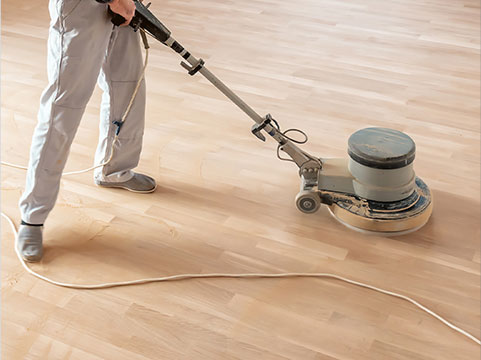
How Non Woven Grinding Discs Deliver Uniform Surface Finishes while Preserving Material Integrity
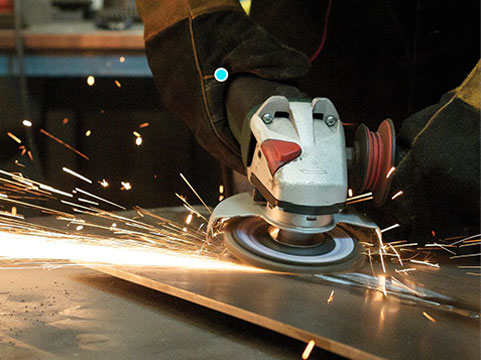
When Sandpaper Pads Fail: Understanding Common Causes of Poor Sanding Performance
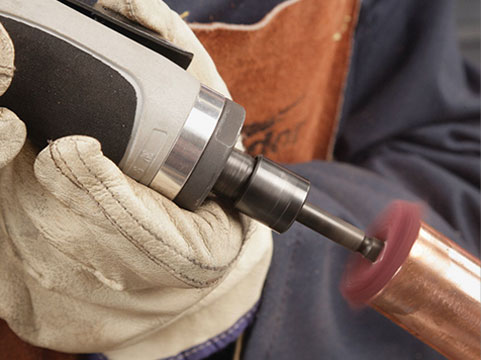
Avoiding Common Mistakes When Choosing and Using Steel Wool Abrasives for Surface Finishing
 EN
EN
 ko
ko  fr
fr  de
de  es
es  it
it  ru
ru  vi
vi  th
th  pl
pl  pt
pt