In maintenance shops and metalworking facilities, the parts that need sanding are rarely flat, standard, or conveniently sized. A technician working through a maintenance backlog on any given shift might need to remove rust from a 2-inch pipe, blend a weld on a structural bracket, deburr a turned shaft on the lathe, and clean up a bearing seat in a confined housing—four different geometries, four different contact requirements, and four situations where a pre-cut sheet of sandpaper is the wrong format for at least three of them.
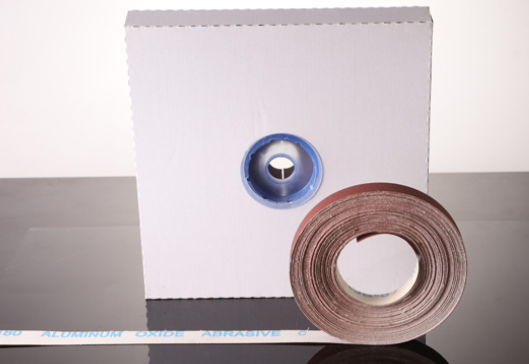
The sanding paper roll—specifically a cloth-backed shop roll designed for industrial maintenance use—solves the format problem that pre-cut sheets create. Industrial sandpaper rolls can be torn to the exact width and length required for each task, wrapped around curved surfaces for full contact, folded into narrow strips for confined spaces, and used on the lathe for controlled wrap sanding on rotating parts. One roll format replaces the collection of pre-cut sheet sizes that maintenance shops accumulate to cover the same range of tasks, and it does so with better conformability on curved parts and less waste per job.
This guide covers the working principle behind cloth-backed shop roll performance, the specifications that determine whether a roll tears cleanly and holds its grain during work, the applications where shop rolls deliver the most productivity advantage, and the TCO model that makes the case for roll format over pre-cut alternatives.
The performance advantage of a cloth-backed shop roll over pre-cut paper sheets on curved and irregular parts is rooted in the mechanics of abrasive contact—how the abrasive surface conforms to the workpiece geometry and how consistently it applies cutting pressure across the contact zone.
A pre-cut paper-backed sheet has limited flexibility. When wrapped around a pipe or shaft, the paper backing resists conforming to the curve, creating a contact zone that is narrower than the sheet width and concentrated at the tangent point. The edges of the sheet lift away from the surface, reducing the effective cutting area and producing a finish that is uneven across the width of the contact zone. On small-diameter pipes and shafts, this effect is pronounced—the sheet may contact only a narrow strip of the surface, requiring more passes to cover the full circumference and producing visible lines where the contact zone edges meet.
A cloth-backed sanding paper roll conforms to curved surfaces naturally. The woven cloth backing flexes around the curve, maintaining contact across the full width of the strip rather than concentrating pressure at the tangent point. The result is more uniform cutting pressure across the contact zone, a more consistent scratch pattern around the circumference, and a finish that is more uniform with fewer passes.
For wrap sanding on shafts and pipes—where the strip is held against the rotating part or the part is rotated against the strip—cloth backing conformability is the specification that determines whether the finish is uniform or shows flat spots and contact lines.
The practical advantage of a roll over pre-cut sheets is the ability to tear exactly the size needed for each task. A strip torn to match the circumference of a pipe provides full wrap coverage without overlap or gap. A narrow strip torn for a bearing seat fits the groove without folding or bunching. A longer strip for lathe sanding provides the grip length needed for controlled contact without requiring the technician to hold multiple sheets together.
This on-demand sizing eliminates the compromises that pre-cut sheets require: folding a sheet to fit a narrow space reduces the effective cutting surface and creates fold lines that produce uneven pressure; using a sheet that is too large for the part wastes abrasive area and makes it difficult to control contact pressure; using a sheet that is too small requires multiple repositioning steps that introduce inconsistency.
For product specifications and configuration options, see the shop roll product page here.
A shop roll specification that addresses only grit and roll dimensions leaves the performance variables that determine daily usability unaddressed. These are the specifications that determine whether a roll performs well in real maintenance shop conditions.
Backing type, cloth grade, and flexibility
Cloth backing grade determines the balance between flexibility and durability. Lighter cloth grades (J-weight) provide maximum flexibility for wrap sanding on small-diameter parts and for use in confined spaces. Heavier cloth grades (X-weight) provide more durability and tear resistance for aggressive stock removal and lathe sanding applications. Match the cloth grade to the primary application—a roll that is too stiff for the smallest diameter parts in the shop's workflow will not conform adequately; a roll that is too light for aggressive applications will tear prematurely.
Grit range and progression
Define the grit sequence required for the shop's primary tasks. Rust removal and scale cleaning typically start at coarser grits; blending and surface preparation for coating progress through intermediate grits; finish preparation for precision parts may require fine grits. Stocking rolls in the grits required for each stage of the shop's workflow—rather than a single compromise grit—reduces the number of passes required to reach the target finish and improves finish quality at each stage.
Resin bond and grain retention under pressure and heat
Grain retention is the specification that determines whether the roll performs consistently throughout its service life or degrades rapidly under the pressure and heat of real sanding work. A bond system that retains grains under the pressure of wrap sanding and the heat generated by friction on metal surfaces maintains consistent cut rate and scratch profile throughout the roll's service life. Request information about the bond system and confirm that it is appropriate for the materials and contact pressures in the shop's applications.
Hand-tearable design without grain shedding
This is the specification combination that most directly affects daily usability in a maintenance shop. A roll that requires scissors or a knife to cut to size slows down every task and is often not cut at all—technicians use whatever length is convenient rather than the optimal length for the task. A hand-tearable roll allows on-the-spot sizing without tools, which is the practical requirement for maintenance work where the next task is always different from the last.
The critical qualification is that easy tearability must not come at the cost of grain retention during work. A roll that tears easily because the backing and bond are weak will also shed grains during sanding—depositing abrasive particles on the workpiece surface, contaminating the work area, and reducing cut rate as grains are lost from the cutting surface. The correct specification is a roll that tears cleanly across the width when pulled against the roll edge, but maintains full grain retention under the lateral and compressive forces of sanding contact.
Roll width and length options
Roll width should match the primary application range in the shop. A 1-inch roll is appropriate for narrow grooves and bearing seats; a 2-inch roll covers most pipe and shaft wrap sanding applications; wider rolls are appropriate for flat surface preparation and lathe sanding on larger-diameter parts. Roll length determines how long a single roll lasts at the shop's consumption rate—longer rolls reduce the frequency of roll changes and the inventory management burden.
The productivity advantage of a sanding paper roll over pre-cut sheets is most significant in specific maintenance and metalworking contexts. These are the applications where format flexibility and cloth backing conformability most directly affect task completion time and finish quality.
Lathe sanding for deburring and blending on turned shafts
Lathe sanding—holding a strip of abrasive against a rotating workpiece on the lathe—is one of the most efficient methods for deburring, blending, and finishing turned shafts, pins, and cylindrical components. The rotating workpiece provides consistent circumferential contact, and the abrasive strip can be moved axially along the part to cover the full length in a controlled, uniform pass.
A cloth-backed shop roll is the correct format for lathe sanding. The cloth backing provides the flexibility to conform to the shaft diameter and the durability to withstand the heat and friction of continuous contact with a rotating metal surface. The hand-tearable format allows the technician to tear a strip of the appropriate length for the shaft diameter and grip requirements without stopping to find cutting tools.
Safety note: lathe sanding requires a defined procedure to prevent the abrasive strip from snagging on the workpiece or the lathe chuck. The strip should be held at both ends with the hands clear of the rotating chuck, and the lathe speed should be appropriate for the workpiece diameter and the abrasive contact pressure.
Hand rust removal and surface preparation on pipes and structural parts
Rust removal on pipes, brackets, valves, and structural components is a daily task in maintenance shops that pre-cut sheets handle poorly. The curved surfaces of pipes require wrap sanding for uniform coverage; the irregular geometry of brackets and valve bodies requires a flexible abrasive that can follow contours; the varying sizes of components in a typical maintenance backlog require different strip sizes for each part.
A shop roll addresses all of these requirements. The technician tears a strip sized for the part at hand, wraps it around the pipe or conforms it to the bracket geometry, and sands with full contact across the strip width. The cloth backing maintains contact around curves without lifting at the edges, producing uniform rust removal across the full contact zone in fewer passes than a paper sheet would require.
Tight and hard-to-reach spaces
Confined spaces—inside pipe ends, narrow channels, bearing housings, and recessed features—are the applications where pre-cut sheets fail most completely. A standard sheet cannot be folded into a narrow strip without creating fold lines that produce uneven pressure and inconsistent scratch patterns. A shop roll strip torn to the exact width of the confined space fits without folding, maintains flat contact across the strip width, and can be worked into the confined space without the bulk of a folded sheet.
For pipe inner wall preparation—cleaning scale, rust, or coating from the inside of a pipe end—a narrow strip torn from a shop roll can be wrapped around a dowel or rod and worked into the pipe interior with controlled contact pressure. This application is impractical with pre-cut sheets of standard dimensions.
Maintenance standardization across multiple task types
A shop that stocks shop rolls in two or three grit ranges can cover the full range of maintenance sanding tasks—rust removal, blending, and finish preparation—with a minimal SKU inventory. The same roll format serves lathe sanding, hand wrap sanding, confined space work, and flat surface preparation, replacing the collection of pre-cut sheet sizes that a shop would otherwise need to stock for the same range of applications.
Step 1: Identify material and defect type
Carbon steel, stainless steel, and aluminum each have different abrasion characteristics and surface sensitivity. Rust and scale removal requires coarser grits and a bond system that resists loading from oxide debris. Paint removal requires a grit and coating type that cuts through the paint film without loading rapidly. Burr removal and blending require intermediate grits that remove material efficiently without leaving scratches too deep for the target finish.
Step 2: Define the contact method
Hand wrap sanding on pipes and shafts requires a flexible cloth backing that conforms to the curve. Lathe sanding requires a durable cloth backing that withstands continuous contact with a rotating surface. Confined space work requires a narrow strip that can be worked into tight areas without folding. Flat surface preparation can use either cloth or paper backing depending on the durability requirement.
Step 3: Choose grit progression to reach the target finish
Define the starting grit based on the severity of the surface condition and the finishing grit based on the target surface roughness before coating or assembly. Use intermediate grits to bridge the gap without large jumps that require excessive dwell time and generate heat.
Step 4: Validate with a short trial and lock in the specification
Run a trial with the selected roll specification on representative parts from the shop's maintenance backlog. Confirm that the cloth backing conforms adequately to the smallest diameter parts in the range, that the grit progression reaches the target finish in an acceptable number of passes, and that the roll tears cleanly and holds grain during work. Document the confirmed specification and stock accordingly.
For maintenance tasks that use hand sanding blocks or dual-action tools with Hook & Loop pads, Velcro-backed sandpaper provides fast disc changes and consistent pad contact that complements the shop roll format for tool-based applications. If the shop's workflow includes both hand wrap sanding and tool-based flat surface preparation, stocking both formats covers the full range of tasks with the appropriate tool for each.
For Velcro-backed sandpaper options that complement the shop roll format, see the AP33M Velcro-backed sandpaper product page here.
Pre-cut sheets are sized for the most common flat surface applications, which means they are the wrong size for most curved and irregular parts. A technician sanding a 1.5-inch pipe with a standard pre-cut sheet uses a fraction of the sheet's area effectively and discards the rest when the used portion is worn. A shop roll strip torn to the pipe circumference uses the full strip area effectively, with no wasted abrasive.
The waste reduction compounds across a maintenance shift where multiple part geometries are processed. Each task uses only the abrasive area required, rather than the fixed area of a pre-cut sheet that may be two or three times larger than the effective contact zone.
A maintenance shop that stocks pre-cut sheets for different applications typically carries multiple sizes—full sheets, half sheets, and quarter sheets in multiple grits—to cover the range of part geometries and task types. A shop roll program in two or three grit ranges covers the same range of applications with fewer line items, simplifying procurement, reducing inventory carrying cost, and eliminating the stockout risk that occurs when a specific pre-cut size runs out.
Better conformability on curved parts reduces the rework rate from uneven finishes that require additional sanding passes to correct. A cloth-backed shop roll strip that maintains full contact around a pipe circumference produces a uniform finish in fewer passes than a paper sheet that contacts only the tangent zone. Fewer passes means less time per part and less abrasive consumption per part—both of which reduce cost per finished part.
Total cost per finished part = consumable cost per part + time-to-prep per part + rework rate × rework cost + inventory carrying cost per SKU
For a maintenance shop processing a mix of flat and curved parts, the consumable cost per part from shop rolls is typically lower than from pre-cut sheets because of reduced waste. The time-to-prep per part is lower because on-the-spot sizing eliminates the folding and repositioning that pre-cut sheets require on curved parts. The rework rate is lower because better conformability produces more consistent finishes on the first pass. The inventory carrying cost is lower because fewer SKUs are required to cover the same range of applications.
When the parts in a maintenance shop's daily workload include pipes, shafts, bearing seats, and confined spaces—which is most maintenance shops—format flexibility is a productivity and quality advantage that pre-cut sheets cannot provide. A cloth-backed sanding paper roll conforms to curved surfaces for uniform contact, tears to the exact size needed for each task without tools, and works effectively in confined spaces where pre-cut sheets cannot reach.
The combination of hand-tearable convenience and grain retention during work is the specification that makes industrial sandpaper rolls practical for daily maintenance use—easy to size on the spot, but reliable in performance throughout the sanding task. With the right grit progression and cloth backing grade for the shop's primary applications, a shop roll program reduces waste, simplifies inventory, and produces more consistent finishes on the curved and irregular parts that pre-cut sheets handle poorly.
Ready to specify the right shop roll for your metalworking and maintenance applications? Submit your requirements for an accurate specification recommendation and quotation.
Visit the Shop Roll Product Page
To receive a specific recommendation, provide the following:
Work conditions: Material type (carbon steel, stainless, aluminum), surface condition (rust, scale, paint, burrs), contact method (hand wrap, lathe sanding, confined space), dry or wet use, workspace constraints
Quantity: Monthly roll consumption, trial order quantity, multi-site MRO demand
Size and specifications: Preferred roll width and length, grit range and sequence, backing flexibility requirement (J-weight or X-weight cloth), hand-tearable requirement
Target metrics: Target finish level and surface roughness, time-per-part goal, acceptable scratch pattern, roll life target
Current problem: Pre-cut sheets don't fit curved parts, excessive waste from oversized sheets, grain shedding during work, inconsistent finish on round parts, difficulty reaching confined spaces
1. What is a sanding paper roll (shop roll)?
A sanding paper roll, also called a shop roll, is a continuous abrasive roll—typically with a cloth backing for flexibility and durability—that can be torn or cut to custom sizes for hand sanding, wrap sanding, lathe sanding, and maintenance applications. Unlike pre-cut sheets, which are fixed in size and format, a shop roll provides on-demand sizing for any part geometry or task requirement. Cloth-backed shop rolls are the standard format for metalworking and industrial maintenance applications because the cloth backing provides the flexibility to conform to curved surfaces and the durability to withstand the pressure and heat of metal sanding. They are available in a range of grit sizes, cloth backing grades, and roll widths and lengths to match different application requirements.
2. How do industrial sandpaper rolls compare with pre-cut sheets or abrasive belts?
Pre-cut sheets are convenient for flat surface applications where the sheet size matches the sanding block or tool, but they are wasteful and poorly suited for curved parts, irregular geometries, and confined spaces. Shop rolls provide the same abrasive performance as pre-cut sheets with the added flexibility of custom sizing for any part geometry, making them more efficient for maintenance shops that process a variety of part types. Abrasive belts are designed for machine-based sanding—belt sanders and wide-belt sanders—where high material removal rates and continuous belt contact are required. They are not adaptable for hand wrap sanding, lathe sanding, or confined space work. Shop rolls fill the gap between pre-cut sheets and machine belts, providing the flexibility of hand sanding with the durability and conformability of cloth backing.
3. What ROI or payback can shop rolls deliver for a maintenance shop?
ROI comes from four sources: reduced consumable waste from on-demand sizing that uses only the abrasive area required for each task; faster task completion from eliminating the folding and repositioning that pre-cut sheets require on curved parts; fewer SKUs to stock and manage, reducing inventory carrying cost and procurement complexity; and lower rework rate from better conformability on curved parts that produces more consistent finishes on the first pass. For maintenance shops with high daily volumes of curved and irregular part sanding, the combined savings from waste reduction and productivity improvement typically justify the transition from pre-cut sheets within the first month of use.
4. Do we need to modify our tools or processes to use sanding paper rolls?
No tool modifications are required for hand sanding and wrap sanding applications—shop rolls are used by hand, with sanding blocks, or wrapped around dowels and rods for confined space work. For lathe sanding, a defined safety procedure is required to prevent the abrasive strip from snagging on the rotating workpiece or chuck. The procedure should specify strip length, grip method, lathe speed range, and workpiece diameter limits for safe lathe sanding. This is an operational procedure addition rather than a tool or equipment modification, and it is standard practice in metalworking shops that use lathe sanding for shaft finishing.
5. What parameters should we provide for correct shop roll selection and an accurate quotation?
Provide: material type and condition (carbon steel with rust, stainless with scale, aluminum with burrs), primary application (rust removal, blending, finish preparation, lathe sanding), part geometry (pipe outer diameter, shaft diameter, bearing seat dimensions, confined space dimensions), grit range required for the task sequence, preferred roll width and length, cloth backing flexibility requirement (light J-weight for small diameters and confined spaces, heavier X-weight for aggressive applications), hand-tearable requirement, and the specific problems you want to solve—whether that is pre-cut sheets not fitting curved parts, excessive waste, grain shedding during work, inconsistent finish on round parts, or difficulty reaching confined spaces.
How Non Woven Grinding Discs Deliver Uniform Surface Finishes while Preserving Material Integrity
When Sandpaper Pads Fail: Understanding Common Causes of Poor Sanding Performance
Avoiding Common Mistakes When Choosing and Using Steel Wool Abrasives for Surface Finishing
 EN
EN
 ko
ko  fr
fr  de
de  es
es  it
it  ru
ru  vi
vi  th
th  pl
pl  pt
pt